New: FreshClock automated perishable markdowns, now shipping on every OmniTag color label. See how it works
Electronic shelf labels for high-volume retail

Never print a price tag again.

OmniTag replaces every paper label on your shelf with a color e-paper display that updates itself from your POS. Prices, promotions, and timed markdowns land in seconds, across every aisle and every store, with nobody walking the floor.

  • 5-year battery, no wires
  • Full-color e-paper
  • Works with your existing POS
  • US-based install & support
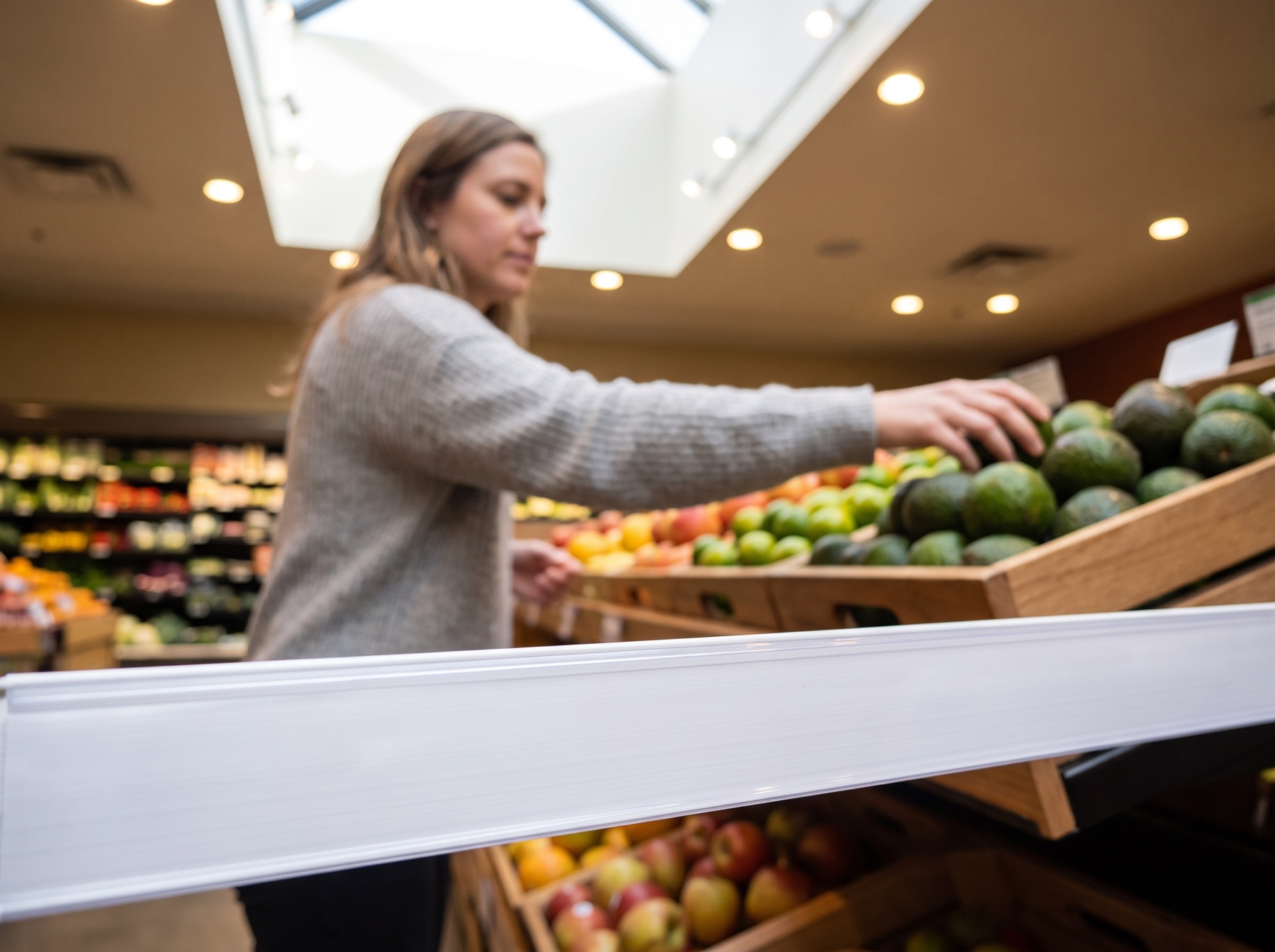
A shopper reaching for avocados in a supermarket produce department, with an OmniTag electronic shelf label on the shelf-edge rail below.
Organic Hass Avocado
PLU 94225
$2.49
Each
Updated 06:00:04 OT-420 · BWRY
Price push · 8s to 214 stores
Aisle 1 · Produce · Live

Built to drop into Toshiba & NCR ECRS CATAPULT LOC SMS Retalix / Aptos Square & Lightspeed Flat-file & REST
The real cost of a paper tag

A paper label costs about eleven cents. Changing it costs three dollars.

The tag is not the expense. The person walking the aisle with a stack of tags is the expense, and they walk it again every single week.

× Paper labels

  • Print, sort, walk, kneel, swap, verify. Repeat for every SKU that moved.
  • Ad breaks start at 6am, so somebody starts at 4am.
  • The shelf and the register disagree from the moment the price changes.
  • Perishables get marked down at end of day, after the sale was already lost.
  • A chainwide change is a multi-day project across every store.
  • Missed tags become customer disputes, re-scans, and refunds.
~14 hrs / store / week Labor spent maintaining prices in a 12,000-label store at 18% weekly change.

✓ OmniTag

  • The POS changes the price. Every affected label changes itself.
  • Ad breaks are scheduled. They fire at 6:00am while the store is empty.
  • Shelf and register read from the same record, always.
  • Markdowns fire on a freshness clock, while the item is still sellable.
  • A chainwide change is one action and eight seconds.
  • Every label reports back. You know it landed, and which ones did not.
~0 hrs Aisle labor to run the same price change, across the same store, every week.

Figures above are the model used in our ROI calculator → — every assumption is shown and editable.

Try it yourself

Change the price. Watch the shelf.

This is the actual interaction. Edit the item, pick a promotion, push it to the shelf. The label flashes the way real e-paper does when it redraws, then holds the new image with the power off.

Price change

What a category manager sees in OmniCloud.

Shelf is up to date
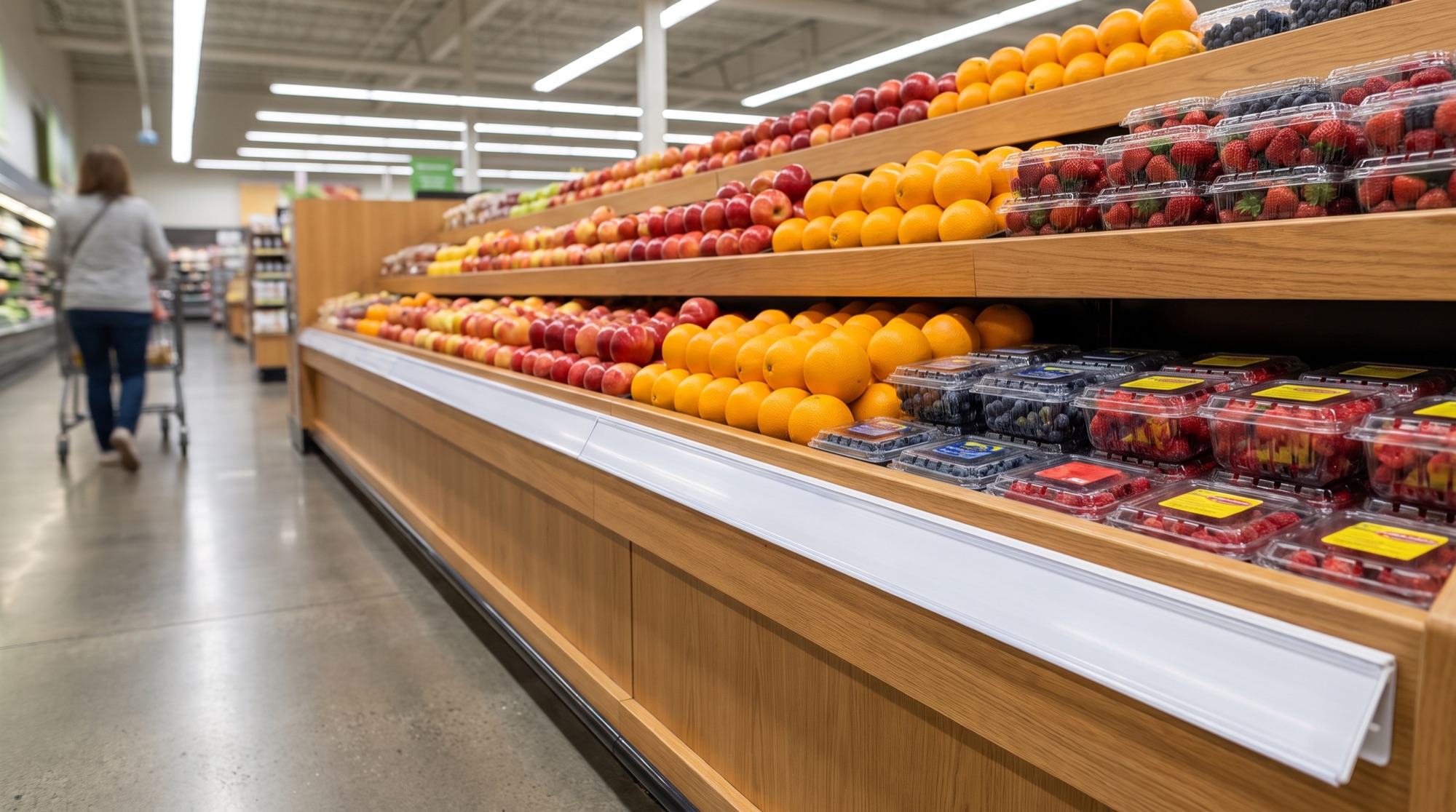
A supermarket produce aisle with an OmniTag electronic shelf label mounted on the shelf-edge rail.
Store 118 · Produce · Rail 4
Organic Hass Avocado
PLU 94225
Weekly Ad
$1.99 $2.49
Each
Updated 06:00:04 OT-420 · BWRY

One label here. In a real store the same push lands on every label bound to that item, in every store in the group, and each one reports back that it took the change.

What the hardware does

Specs, not slogans.

<2s
Full-page refresh, from push to visible on the shelf
5yr
Battery life at two updates per day, replaceable cell
15,000
Labels managed by a single ceiling-mounted access point
4-color
Black, white, red and yellow e-paper on every label
FreshClock · automated markdowns

Fresh prices at the speed of fresh produce.

Perishables lose value on a clock, not on a calendar. FreshClock reads the received date on the case, watches the shelf life you set, and steps the price down on its own schedule so the discount lands while a customer will still buy it.

  • Set the rule once per category: day 4 at 20% off, day 5 at 40%, pull on day 6.
  • The tag flips to red and prints the reason. "Ripe today." "Best by tonight."
  • Shrink you were writing off becomes margin you actually collected.
  • The markdown reaches the register at the same instant it reaches the shelf.
See the fresh-aisle playbook

Timed, not manual

Markdowns run off a received-date clock instead of whoever remembers to do the walk.

Margin you keep

Discount early and shallow beats discounting late and deep. The clock enforces it.

Reason on the tag

Shoppers trust a discount that explains itself. Color e-paper has the room to say why.

Measured, per SKU

Every markdown is logged, so you can see which rules recovered margin and which did not.

The hardware

One family, from the price tag to the endcap.

Seven display sizes on one radio, one battery platform, and one management console. You do not run a different system for the freezer than you run for the shelf.

Shelf standard
Gala Apples
$1.79
PER LB · PLU 4133

OT-290

2.9"

The everyday shelf-edge price tag. Four-color, 9.4 mm thin, and the volume workhorse in a grocery rollout.

BWRY296×128NFC
Most deployed
Organic Hass Avocado
$1.49
EACH · RIPE TODAY · 40% OFF

OT-420

4.2"

Room for the promo reason, the unit price, and a QR code without shrinking the number a shopper actually reads.

BWRY400×300NFCLED
Cold chain
Frozen Wild Salmon
$11.99
PER LB · −25°C RATED

OT-290F

2.9" freezer

Sealed, condensation-tolerant, and specified to refresh cleanly at −25 °C inside a closed freezer case.

BWRIP65−25°C
How it works

Three pieces. Your POS never has to change.

OmniTag listens to the price file you already produce. It does not ask you to re-platform, re-key, or maintain a second source of truth.

01 · Labels

Color e-paper tags

Battery-powered displays on the shelf edge. They hold an image with zero power and only wake to receive a change.

  • 2.13" to 11.6", black / white / red / yellow
  • Five-year coin cell, field-replaceable
  • NFC tap for on-the-spot binding
02 · Gateway

Ceiling access points

A small number of PoE access points cover the salesfloor and carry updates out to every label in range.

  • Up to 15,000 labels per access point
  • Standard PoE, no new cabling runs
  • Two-way: every tag confirms receipt
03 · OmniCloud

The console

Where templates, promo rules, freshness clocks, and store hierarchy live. One login for one store or four hundred.

  • Ingests your POS price file, REST or flat-file
  • Rules engine for ads, loyalty, and markdowns
  • Per-label audit trail and health reporting
POS price change → OmniCloud rules → access point → label refreshes → confirmation back to console
Where it goes

Anywhere a price is printed by hand.

🥬

Grocery & Supermarket

Weekly ads, fresh markdowns, and 40,000 SKUs that never disagree with the register.

🧊

Cold Chain & Freezer

Sealed labels rated to −25 °C that stay legible through the case door.

📦

Warehouse & 3PL

Bin labels and pick-to-light with a button and an LED on every location.

💊

Pharmacy

Regulated pricing, planogram compliance, and shelf-level stock signalling.

🔩

Hardware & Trade

Long-tail SKUs, contractor pricing tiers, and bin-level accuracy without a print room.

🚗

Auto Dealership

Window stickers and lot pricing that move with the market instead of with the printer.

🌿

Garden & Nursery

Outdoor-rated labels for live goods that get marked down on a growing clock.

🏢

Workplace

Room booking, desk hoteling, and asset tags on the same network as the shelf labels.

Run the numbers

See what your aisle labor is actually costing you.

Put in your store count, label count, and how often prices move. The calculator shows the labor hours, the pricing-error leakage, and the shrink you are currently eating, with every assumption on screen and editable.

Straight answers

The questions every buyer asks first.

No. OmniTag consumes the price file your POS already produces. We support REST, SFTP flat-file, and direct connectors for the common grocery and retail platforms. Your POS stays the single source of truth; we just make the shelf agree with it.

A single 12,000-label store is typically three to five days on site: access points first, then labels hung and bound by NFC tap, aisle by aisle, while the store stays open. Multi-store chains run as a repeatable per-store package after the first pilot is signed off.

It cannot go unnoticed. Communication is two-way, so every label acknowledges the change it received. Anything that did not confirm shows up in the console as an exception with its aisle and position, and it retries on the next cycle. You get a list, not a surprise at the register.

It depends on size and volume, so we quote rather than post a price. As a planning figure, budget roughly $9 per label installed for the common 2.9" and 4.2" sizes, one access point per 400 labels, and a per-label annual platform fee. The ROI calculator uses those same numbers and shows them to you.

Cells are field-replaceable and the console reports remaining life per label, so replacement is scheduled by aisle rather than discovered by a blank tag. At two updates per day you are looking at roughly a five-year cycle, and the replacement pass is a fraction of the labor a single week of paper tagging costs.

That is the recommended way in. Most rollouts begin with produce or meat, because that is where markdown automation pays back fastest, and expand aisle by aisle once the numbers are in hand. We will scope a single-department pilot with a fixed price and a defined measurement window.

Stop chasing paper tags.

Tell us your store count and label count. We will come back with a quote, a hardware plan, and a pilot you can actually measure.